Showing posts with label corporate. Show all posts

Wednesday, 12 January 2022

Industrial Visits and their importance in colleges


Industrial Visits is like a school trip. Students get elated by the idea of visiting an unknown place outside their college. Even if that place is an industry. It is like exploring a new world by itself. Industrial visits have become an essential part of many graduate and post-graduate courses in colleges. Why is it so and how do industrial visits contribute to shaping a student’s career? Let’s learn in this section.

Industrial visit is the first point of contact of a student towards the corporal world. It gives a glimpse into the core industrial life beyond academics. It offers first-hand exposure to the business operations and processes in that workplace. It helps in bridging the gap between academics and corporate for the successful transition of students into capable employees. 


Advantages of Industrial Visits:

Learning exposure: Industrial visits are educational tours that let students see the operations, workstations, plants, machines, assembly lines, and management of industry and meet experienced professionals. This experience complements the theory they have learned so far by seeing the processes up close. A lot can be understood by observation than words in a book. They learn about the policies and the working schedules of that industry. This ultimately helps them build their confidence for their future as what seemed far-fetched earlier isn’t so anymore.

Chance to interact with Industrial Experts: Besides observing the nitty grit of the industry, students also get an opportunity to greet and learn well-renowned professionals, industrialists, entrepreneurs, managers, and leaders. These professionals share their experiences and words of wisdom that motivate them to follow their own career aspirations. These educational interactions help them inculcate leadership qualities and management skills in them. It also helps teachers and students stay relevant to the latest trends and technology in the industry.

Personal Management Lessons: Since the students get an opportunity to see the employees work up close, they get a short trailer into their corporal lives. They are introduced to various managerial concepts and how they are performed in action. For a manager, it requires a certain strategy and experience to manage dozens of workers to meet the standard target of the company within the deadline. It is not an easy task. Students get to observe this which ultimately becomes a career lesson that they can apply in the future. 

Boost interpersonal skills: By observing and learning from these educational visits, students enhance their interpersonal skills, communication skills, and teamwork. They realize the importance of these skills that help immensely in corporate life. For both B. Tech and MBA students, this experience aids them in identifying their career goals in life. MBA students can decide which management branch they want to lean on later from marketing, accounting, finance, HR, IT, etc.


Boost employability: Industrial visits give a leeway to expand networks and build a civilized work relationship with those companies. Students gain some valuable insights about the company, eventually connecting them through social media sites such as LinkedIn, Instagram, Facebook, and Twitter. This provides opportunities such as internships and training which in turn increases the employability of the students. 


A different day than usual: We all need a little break from our routine from time to time. These industrial visits give students a refreshment from the endless routine of classes and assignments. They get a chance to step outside as well as learn something new, thus killing two birds with one stone. Just like an ordinary tip, they get to connect with their batchmates and teachers. All in all, it becomes a fun learning experience. 


Industrial Visits at ITS Engineering College 

ITS Engineering College is a premium institute of Engineering & Management in Greater Noida that has been running since 2006. The college understands the importance of industrial trips and their role in the student’s career development. Hence the administration makes a point to organize an industrial visit per semester to let the students get in touch with the practicality of their curriculum. Educational experiences like this eventually gear them up for the business world.

Some of the key visits undertaken by ITS Engineering are:

  • Department of ECE and EEE organized an industrial visit to M/s ENKAY Solar Power Limited on October 19, 2021. It was coordinated by Mr. Prabhakar Sharma, AP-ECE & Mr. Upendra K. Agarwal, AP-EEE.

  • Department of Computer Science & Engineering organized an industrial visit to Bisleri International Pvt Ltd for B tech II years on October 10, 2019. It was coordinated by Mr. Aditya Dayal Tyagi and Mr. Vijay Shukla, who along with students interacted with the HR and the front office executives.

  • Department of MBA organized an industrial visit to Anmol Industries Ltd., Greater Noida on October 11, 2019. The goal was to give an insight into the internal working strategy of the company and gain exposure. It was coordinated by Professor Rashmi Kaushik and Professor Sachin Sinha.

  • Department of Applied Sciences and Humanities organized an industrial visit to Mother Dairy Plant at New Delhi for B. Tech first-year students. It was coordinated by Dr. P. C. Jha, along with Mr. Surinder Singh and Mr. Neeraj Tripathi.

  • Department of Mechanical Engineering organized an industrial visit to Carlsberg India Pvt. Ltd., Dharuhera for B. Tech Final year students. The company is known for manufacturing well-known brands of beer. It was coordinated by Mr. Rohan Srivastava, Mr. Chetan Dixit, and Ms. Preeti Singh.

  • Department of Electrical and Electronics Engineering organized an industrial visit to the National Power Training Institute (NPTI) Ministry of Power, Govt. of India in Faridabad. The main objective was to showcase the various processes involved in the operation and maintenance of power stations and all other aspects of electrical energy systems including transmission, sub-transmission, and distribution. 

Written By

Shaily Rai


Thursday, 30 January 2020

Data types in Python: Numeric Data Type

Python is a clear and powerful object-oriented programming language, comparable to Perl, Ruby, Scheme, or JavaIn my last blog we have discussed the key features of python. Now we are going to dive into the programming concepts of python. In this blog we will discuss about data types used in the python
   
Data Types
Data types are the classification or categorization of data items. It represents the kind of value a particular variable can hold and tells what operations can be performed on that particular data.
   
Since everything is an object in Python programming, data types are actually classes and variables are instance (object) of these classes. The type of a variable in the python is decided by the type of value assigned to that variable.
   
Example:
   
# type() function is used to identify the datatype of variable or object.
>>> x = 10
>>> type(x)
<class 'int'>
>>> x = 10.0
>>> type(x)
<class 'float'>
>>> x = 5+8j
>>> type(x)
<class 'complex'>
>>> x = 'Mukesh'
>>> type(x)
<class 'str'>
>>> x = ['Mukesh','Kumar']
>>> type(x)
<class 'list'>
>>> x = ('Mukesh', 'Kumar')
>>> type(x)
<class 'tuple'>
>>> x = {'fname':'Mukesh', 'lname':'Kumar'}
>>> type(x)
<class 'dict'>
>>>
   

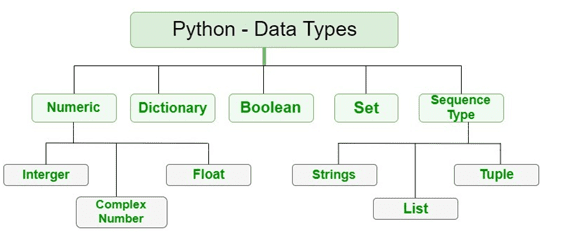
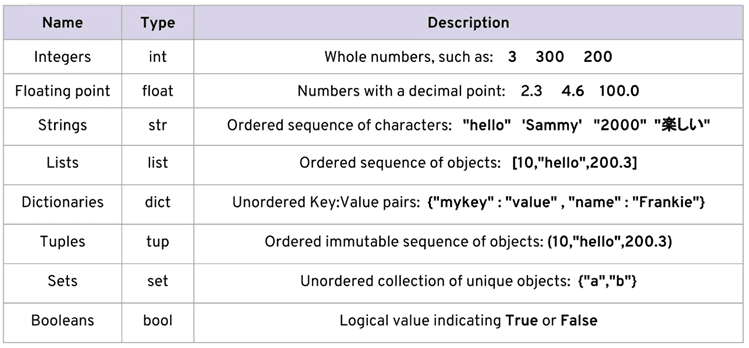
Built-in data type of python are as follows:
                            
Let us discuss about Numeric Data type

Numbers
The Python interpreter acts as a simple calculator, You can write an expression and interpreter will display the value. Expression syntax is straight forward: the operators +, -, * and / work just like in most other languages (for example, Pascal or C); parentheses (()) can be used for grouping.

Examples

>>> 7 + 3
10
>>> 70 - 5*6
40
>>> (70 - 5*6) / 4
10.0
>>> 9 / 5  # division always returns a floating point number
1.8

There are three distinct numeric types: integersfloating point numbers, and complex numbers. In addition, Booleans are a subtype of integers.

Integers
This value is represented by ‘int class. It contains positive or negative whole numbers (without fraction or decimal). In Python there is no limit to how long an integer value can be.

Float
This value is represented by ‘float class. It is a real number with floating point representation and specified by a decimal point.

Complex Numbers
Complex number is represented by ‘complex class. It is specified as (real part) + (imaginary part)j. For example – 5+8j

Basic Operations on Numeric Type
The integer numbers (e.g. 2, 4, 20) have type ‘int’, the ones with a fractional part (e.g. 5.0, 1.6) have type  ‘float’.

Division (/) always returns a float. To do floor division and get an integer result (discarding any fractional result) you can use the // operator; to calculate the remainder you can use %:

Examples
>>> 7+3 # addition operator
10
>>> 7-3 #minus operator
4
>>> 7*3 #multiplication operator
21
>>> 17 / 3  # classic division returns a float
5.666666666666667
>>> 
>>> 17 // 3  # floor division discards the fractional part
5
>>> 17 % 3  # the % operator returns the remainder of the division
2
>>> 5 * 3 + 2  # result * divisor + remainder
17

With Python, it is possible to use the ** operator to calculate powers

>>> 5 ** 2  # 5 squared
25
>>> 2 ** 7  # 2 to the power of 7
128

The equal sign (=) is used to assign a value to a variable. Afterwards, no result is displayed before the next interactive prompt:

>>> width = 20
>>> height = 5 * 9
>>> width * height
900

If a variable is not “defined” (assigned a value), trying to use it will give you an error:

>>> n  # try to access an undefined variable
Traceback (most recent call last):
  File "<stdin>", line 1, in <module>
NameError: name 'n' is not defined

There is full support for floating point; operators with mixed type operands convert the integer operand to floating point:

>>> 4 * 3.75 - 1
14.0

In interactive mode, the last printed expression is assigned to the variable _. This means that when you are using Python as a desk calculator, it is somewhat easier to continue calculations, for example:

>>> tax = 12.5 / 100
>>> price = 100.50
>>> price * tax
12.5625
>>> price + _
113.0625
>>> round(_, 2)
113.06

This variable should be treated as read-only by the user. Don’t explicitly assign a value to it — you would create an independent local variable with the same name masking the built-in variable with its magic behavior.

All numeric types (except complex) support the following operations:

   
Operation
Result
Full documentation
x + y
sum of x and y
   
x – y
difference of x and y
   
x * y
product of x and y
   
x / y
quotient of x and y
   
x // y
floored quotient of x and y
   
x % y
remainder of x / y
   
-x
x negated
   
+x
x unchanged
   
abs(x)
absolute value or magnitude of x
int(x)
x converted to integer
float(x)
x converted to floating point
complex(re, im)
a complex number with real part ‘re, imaginary part ‘im. im defaults to zero.
c.conjugate()
conjugate of the complex number c
   
divmod(x, y)
the pair (x // y, x % y)
pow(x, y)
x to the power y
x ** y
x to the power y
   

Saturday, 11 January 2020

Importance of Industry Visits in MBA


The Industry Visit in MBA focuses on preparing the students to learn about the day-to-day workings of a particular industry and understand its operational issues. It also helps in keeping them abreast with the current management practices followed by such organizations and acquire traits that the industry demands of them.
The Department of MBA at the ITS Engineering College, Greater Noida, recognizes the fact that industry visits are a significant component for development of its students. We feel it is fruitful that the students with academic background have a glimpse of the industry in order to have an improved understanding of practical applications of theory. It provides them with an opportunity to learn practically through interaction, working methods and employment practices.
As a part of the curriculum, our students are required to undertake few industry visits to various industries of repute every semester. This provides them with the real insight of working procedure of an esteemed firm. These visits are an overwhelming yet knowledgeable experience for our students.
Our Department of MBA has organized numerous industry visits in the past. The list includes visits to very renowned and reputed organizations such as Coca-Cola India, Yamaha India, Container Corporation of India, Bisleri, Yakult, Parle, CNH Industrial and Anmol Industries.