Showing posts with label best engineering college. Show all posts

Thursday, 21 October 2021

Artificial Intelligence & Machine Learning engineering course in ITS Engineering College


--Written by Shaily Rai

ITS Engineering College in Greater Noida has opened its doors to a new branch of engineering in Bachelor of technology—Artificial Intelligence & Machine learning (Al & Ml), from the academic year 2021 onwards.

What is Artificial intelligence?

Artificial Intelligence is the new computer of technology. In simple words, AI gives life to the machines—by giving them intelligence. This enables the machine to imitate humans in terms of perception, decision making, speech recognition, and language interpretation. And the way we can construct Ai is through Machine learning. Ml is the tool required for the machines to make intelligent decisions based on algorithms and historical data. Some of the well-known applications of AI include Siri, Google Maps, Google assistant, data bot, music and media streaming services, etc. It is like creating a mini robot inside the software.

AI and ML are a subset of Computer science engineering. What separates AI from computer & computer applications is unlike most computer software's that are required to be pre-programmed, AI does not require that. Instead, they require machine learning algorithms like reinforcement learning algorithms and deep learning neural networks in order to work with their intelligence.

Scope of AI & ML.

The world we see today is mostly driven by technology. The smartphone we carry every day is the best example of that. Artificial Intelligence aims to add another dimension to that technology by solving real-time problems, thus meeting the goals of organizations and humans in general. The requirement of AI is spread into various fields such as robotics, games, finance, cyber security, social media, driver less automobiles, health, space technology—the opportunities are endless. An example of its usage was at the time of the Covid pandemic where AI-assisted in the development of vaccines with its analytical predictions and machine learning.

AI is like a developing country that is growing rapidly and still has room to evolve more. There are three kinds of working AI- Weak AI, general AI, and strong AI. In terms of capabilities, AI is still at the weak and general level. It has yet to evolve into a strong AI. Scientists have planned to modify AI to the point where it will track and analyze patients in real-time and help combat fatal diseases such as cancer. While driverless cars are already in use, albeit rarely, they will predictably replace a large number of regular automobiles in the coming decades. These were just some of the examples of AI and its scope in the future.

Artificial Intelligence & Machine learning jobs.

According to the report prepared by the World Economic Forum, there will be a requirement of 58 million new Artificial intelligence jobs by the end of 2022. AI is continuing to take over technology, thus increasing the demand for artificial intelligence & machine learning jobs in various industries. The subject of Machine learning is crucial for building AI and will be made as mandatory as programming in the coming years. Some of the jobs posts of AI & ML include Artificial intelligence engineer, data scientist, software engineer, robotics engineer, machine learning engineer, AI researcher, ML architect, etc. While some of the well-known AI companies based in India are Dixon, Google, Adobe, Amazon, Wipro, Honeywall Automation, Pfizer, etc.

AI & ML in ITS Engineering College

Being aware of its vast growing aspects, ITS Engineering College in Greater Noida has added Artificial Intelligence & Machine Learning course into its educational structure. The course of AI will include machine learning, automation, neural networks, algorithms, language processing, robotics, pattern recognition amongst others. The duration of the B Tech AI & ML engineering will be of 4 years, comprising of 8 semesters in total.

ITS Engineering College, Greater Noida is affiliated with Dr. A.P.J. Abdul Kalam Technical University and is the best engineering college in AKTU. The students studying here are blessed with a myriad of opportunities through interactive workshops, entrepreneurship programs, internships, industry visits, expert talks, virtual classroom sessions, and job placements in top-notch companies. They also train their students on non-technical soft skills to prepare them for the corporate world, thus securing their future in artificial intelligence.

We believe this is the best time for students to choose AI as their career path at a time when it is thriving in the technological world globally. Students seeking admission in these programs for the session 2021 can register themselves through the ITS Engineering official website https://www.itsengg.edu.in/ 


Wednesday, 17 June 2020

Computer Science Engineering Teaching Practices at ITS

Why Computer Science Engineering at ITS

Today's Scenario

Today the world is rushing towards modernization and computerization whether it is in professional, industrial, social, defense or occupational field. Commuters help in working faster without errors and a lot of data can be stored in a small space. Software industries and Technology giants want highly qualified and intelligent people at their workplace. So that they can develop the best services or products by hiring intelligent people.The technology-driven era has a plethora of options for those who have excellent coding skills and are interested in learning new languages and finding solutions to problems through computer programming.


Market Trend

Computer science has contributed a lot for making the life of human being smooth. The recent developments in the field of computer science are proven to be more smarter and more applicable structures result from marrying the learning capability of the applications with the transparency and accuracy. With the advent of the modern technological age, people and surrounded things get connected with each other. For protecting those connections, there is a great need for the students of Computer Science Engineering to protect the security of these connections. 

Change is the only constant. This applies to your professional life as well. Up-skilling yourself is a need nowadays, the reason is pretty simple, technology is evolving very quickly. Following are the new areas of work for Computer Science Students.

1. Artificial Intelligence (AI) 

2. Machine Learning (ML)

3. Internet of Things (IOT)

4. 5G (Mobile Network)

5. Block Chain

6. Cyber Security

7. Voice Technology

8. Edge Computing

9. Virtual Reality

10.Robotic Process Automation

Scope Of Computer Science

How ITS Engineering College Gives Training To Computer Science Students

Top companies are scrambling to recruit technology savvy engineering graduates. ITS Engineering College gives its computer softwares students an edge over other college students in the competitive tech based market.


First Step is To Give Clarity Of New Computer Technologies

Before introducing any new technology topic to students be it Artificial Intelligence, Machine learning or any computer based learning technologies the faculty first clears that what are the learning goals, and provides explicit criteria on how students can be successful. It's ideal to also present models or examples to students so they can see what the end product looks like.


Networking Opportunities

As there is a lot of evolution of new technologies, every student at ITS is free to connect with other students, faculties or even internet to understand new technologies and have access to latest updates regaring IT Industry. Most ITS Students who choose connection based learning tend to have more access to information regarding new technologies.


Increased Faculty Student Interaction

To get better understanding of new computer driven technologies Faculty at ITS are always available on all modes of new generation communications. We at ITS prefer to give quality time to students so that the student can understand and the more the student interacts with the faculty or other students about a concept, the more will be the effect of learning. This increases the chances of a student performing well due to the time their faculty give them. This also enhances their problem-solving and communication skills, as well as knowing how to defend their arguments to superiors if needed.


Industry Oriented Labs - Center Of Excellence

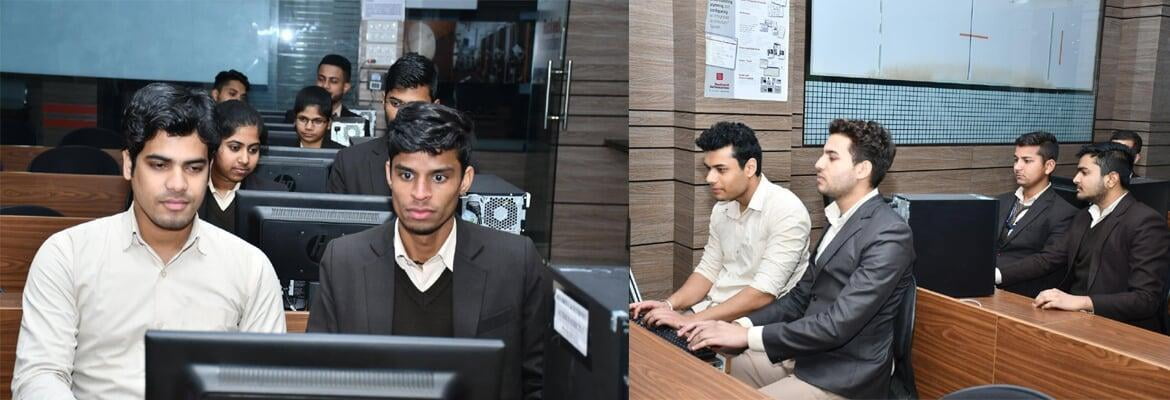
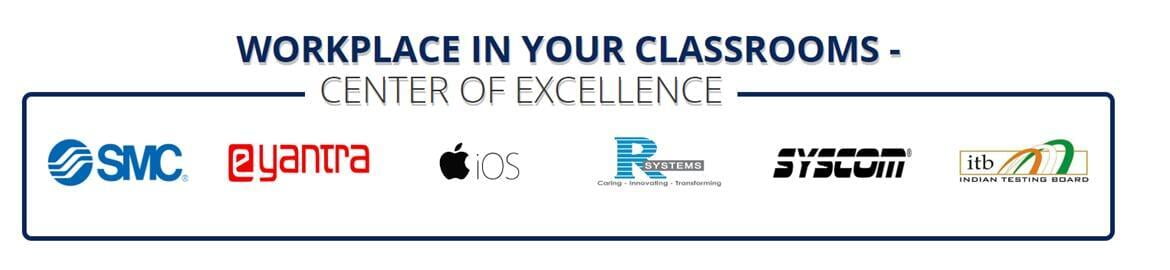
ITS Engineering College has setup industry oriented computer labs for its computer science students to get project based exposure. These Industry simulated environments are giving exposure to students to the latest cutting edge technologies in Industry. Also, the students are having access to an online learning platform for unique set of Industry oriented engineering course modules. We have separate labs for our computer students specially setup ed to learn new technologies in the area of computer science. Apple IOs Programming Lab, Syscom Lab, R Systems lab and ITB & SALT software testing labs are setup ed in the ITS Engineering College Premises. 


Project Based Assessments

Projects can be defined as a planned undertaking to accomplish a specific aim, and have been a valuable part of learning for a long time. We at ITS focus more on practical and Project Based Learning. The Computer Technology learning area has the most synergy with a project based learning approach. The inquiry and design processes that are central to project-based learning are also central to the Technology learning area. As such, Technology provides a structure to explore knowledge and issues in other learning areas. Software programming, debugging, software testing, Dev Ops, JAVA, C#, Python ect are some of the programming languages which are more focused on projects.


Access to Expertise Online

Specially designed for computer science engineers allows the sharing of expertise that helps more students have access to education that is not readily available over the internet. The whole premises of ITS Engineering College is enabled with High Speed Internet wifi for students to access information while and after their college sessions.

Saturday, 7 March 2020

Do You Need To Be Good At Math For Computer Science?

If there is one subject that has equal lovers and haters, it is definitely mathematics. Math is one of the most important subjects of our school time and interestingly many career choices depend on how good you are in the subject. No wonder, every student asking this question – is it important to be good at Math to pursue computer science? The question becomes imperative because if you aspire to take admission in the best engineering college for computer science, it is important to have expert-level in all three subjects of Non Medical – Physics, Chemistry and Math. So before we give you a concrete answer to the question, let us first tell you how computer science and Math are related.

Computer science is all about using computer programs and practical approach to creating applications related with computers. So how does mathematics fit in between computer science and programming? The answer is – there are certain subjects of mathematics like calculus, probability, statistics, linear algebra, linear programming etc that are purely related with computer science and computer programming. So all those students who wish to pursue their higher education in one of the best engineering colleges for computer science and build their career in creating applications or programming, good mathematics is the best bonus they can ask for!

The simple way to correlate your career interest and choice is that everyone who is good at mathematics can surely go for computer science but that shouldn’t stop you from taking computer science if you are just an average student in Math. Computer science is a vast field and there are many things that a student can do with just basic understanding of Math like web app development, operating systems etc. You can excel in other branches than programming or coding in computer science engineering even if you are not a topper in mathematics.

Student who wants to build a flourishing career in programming, good mathematical mind is a big strength. In fact, you are not expected to be good at arithmetic, calculations or geometry, computer science engineering is best done when students have a strong mathematical thinking.

For that matter, if you wish to do engineering in any other field than computer science; say mechanical engineering or electronics engineering; your marks and expertise level in three subjects – Physics, Chemistry and Mathematics, decide which institute you get admission in to and for what branch of engineering. So computer science engineering students are by default expected to be good at Math. Moreover, if you want to build a career in artificial intelligence, command in statistics, calculus, probability, logic and a little bit of knowledge of all these branches of mathematics would help you learn faster and better.


Tuesday, 25 February 2020

B.Tech after Polytechnic

B.Tech is one of the most popular career options for the youth of India. The degree is preferred because it has value in terms of money, name, fame and respect. Secondly, B.Tech students add a lot of value to the current life, lifestyle, public infrastructure and developmental projects all around the world.

There are hundreds of B. Tech colleges in Uttar Pradesh that are currently imparting education to thousands of polytechnic students. So yes, you can join a B.Tech program after completing your polytechnic course. Taking admission in a reputable B.Tech course is possible through two examinations. The first one is a lateral entry entrance examination and the other is the engineering entrance examination. When it comes to employment, there are a lot of benefits when you combine polytechnic with a reputable B.Tech degree or diploma from a recognized institution in the current scenario.

Taking admission in a B. Tech course through lateral entry examination after your polytechnic will enable you to begin with the second year of engineering directly. The lateral entry examination is a state-level test. You will be allowed to choose your college from your state according to your rank. This decision will be made at the time of your counselling. Most B.Tech colleges in Haryana and across the country reserve a few seats for lateral entry. Do bear in mind that there are no lateral entry seats in the IITs.

If you choose to take the engineering entrance exam, you will have to appear for the test to get admission in the first year of B.Tech. If you are aiming for an IIT or NIT, this test might be the right path to take. Joining a B.Tech program after completing your polytechnic improves your chances of getting employment across different industry verticals.

Experts recommend that you should research well about the best B.Tech colleges in Delhi NCR/ Uttar Pradesh before finalizing your decision. Going by the statistics of annual pay packages received by the students of engineering colleges, their placement records and the success of past students; ITS Engineering College emerges to be the best and top choice for doing B. Tech.


Monday, 10 February 2020

Scope in ECE

Even imagining a life bereft of electronic gadgets seems impossible in today’s world. There is no field left across the globe where one cannot find the usage of electronics and communication engineering. Perhaps that is why electronics have become the vertebrae of digital technology. However, as a student planning to pursue Electronics and Communication Engineering (ECE) courses in India.
Undoubtedly, selecting a branch of engineering from myriad options is like searching a needle from a needle stack. It is bewildering and that is why most of the students end up making the wrong choice. To avoid this, here the potential of ECE courses in paving a successful career has been discussed.
Gleaming Future Prospects of ECE
This question usually pops up in the minds of many students that why to choose Electronics and Communication Engineering courses and what makes it an ideal option. Well, to answer this, it will be important to take a look at the figure provided by the Bureau Labor of Statistics (BLS).
It is predicted that the jobs for engineers will grow by 7% from 2016 to 2026. Furthermore, it has also been found that the employment in the ECE sector has amplified significantly in the last few years.
The reason behind this positive change of wind is the growing nexus between the electronics industry and the digital technology. The application of ECE in fields, such as satellite and mobile communication, digital telecommunication, power electronics, etc. has created amazing career options. Apart from this, manufacturing companies, Multinational Corporations (MNCs), research-based or industrial corporations, government authorities, aerospace manufacturing companies, consumer electronics manufacturing, healthcare tools manufacturing, Armed forces (Army/ Air Force/Navy), many others look for candidates  with ECE background.
ECE engineers expertise in managing large scale research, conceptualizing, designing, developing and testing of the electronic equipment used in latest communication devices and other handy technological equipment, such as smart phones, tablets, processors, smart wrist watches, smart LED TV’s, etc. has only led to the surge in their demand.
In a nutshell, one can say that the skills of ECE engineers in planning, executing the testing process, framing of the system layouts, and delivering the end product in an impeccable way enhances their market value. This means that as an aspiring student of ECE, candidates need to ensure they select the right course in Electronics & Communication Engineering, in which they have interest and which offers better career options in the future.
In the scope in ECE one of our student team won prize in research paper presentation at IISC Bangalore.
https://www.itsengg.edu.in/blogs/

Thursday, 30 January 2020

Motors in Electric Vehicle

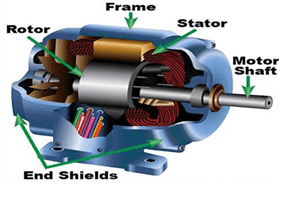
Due to worse effect of fossil fuel on environment, Electric vehicle (EV) was introduced. The core element of the EV, apart from Batteries, which replaces the Internal Combustion engines is an Electric motor. Older designs used standard DC motors, which are relatively economically controlled when driven with batteries. New designs use either AC Induction motors or Permanent Magnet Rotor AC motors, driven by electronic inverters. In general, lower power applications will use the PM AC motors which are slightly more efficient for a given task, while high-performance vehicles will use induction motors since they are capable of very large acceleration torques relative to their weight for short intervals, until they overheat. All new Electric Vehicles and even hybrids use AC electric motors. They are lighter, more powerful and can be used as a generator makes power as you slow down or brake called Regenerative braking. 
Permanent Magnet AC Motor
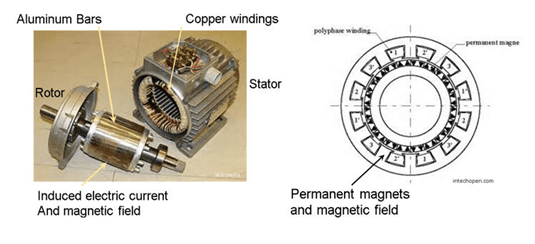
Permanent magnet AC motors (PMAC) are just like standard induction AC motors except they have permanent, rare-earth magnets attached to their rotors. Having these permanent magnets instead of electromagnets reduces energy losses in the motor. They are also called synchronous AC motors.  Most of the automotive manufacturers use PMAC motors for their hybrid and electric vehicles. For example, Toyota Prius, Chevrolet Bolt EV, Ford Focus Electric, zero motorcycles S/SR, Nissan Leaf, Hinda Accord, BMW i3, etc use PMAC motor for propulsion.

AC Induction Motors
Induction motor works on the principle of induction where electro-magnetic field is induced into the rotor when rotating magnetic field of stator cuts the stationary rotor. Induction machines are by far the most common type of motor used in industrial, commercial or residential settings. Squirrel cage induction motors have a long life due to less maintenance. Induction motors can be designed up to an efficiency of 92-95%. The drawback of an induction motor is that it requires complex inverter circuit and control of the motor is difficult.

Typically, most of the manufacturers use synchronous motors, but whether it is a permanent magnet or electromagnet strongly influences the performance. The key difference is that AC induction motors have to use electricity to generate the magnetic currents inside the motor, which cause the rotor to spin, whereas a permanent magnet motor doesn’t require that additional current since its magnets—created from rare-earth materials—are always “on.”

Data types in Python: Numeric Data Type

Python is a clear and powerful object-oriented programming language, comparable to Perl, Ruby, Scheme, or JavaIn my last blog we have discussed the key features of python. Now we are going to dive into the programming concepts of python. In this blog we will discuss about data types used in the python
   
Data Types
Data types are the classification or categorization of data items. It represents the kind of value a particular variable can hold and tells what operations can be performed on that particular data.
   
Since everything is an object in Python programming, data types are actually classes and variables are instance (object) of these classes. The type of a variable in the python is decided by the type of value assigned to that variable.
   
Example:
   
# type() function is used to identify the datatype of variable or object.
>>> x = 10
>>> type(x)
<class 'int'>
>>> x = 10.0
>>> type(x)
<class 'float'>
>>> x = 5+8j
>>> type(x)
<class 'complex'>
>>> x = 'Mukesh'
>>> type(x)
<class 'str'>
>>> x = ['Mukesh','Kumar']
>>> type(x)
<class 'list'>
>>> x = ('Mukesh', 'Kumar')
>>> type(x)
<class 'tuple'>
>>> x = {'fname':'Mukesh', 'lname':'Kumar'}
>>> type(x)
<class 'dict'>
>>>
   

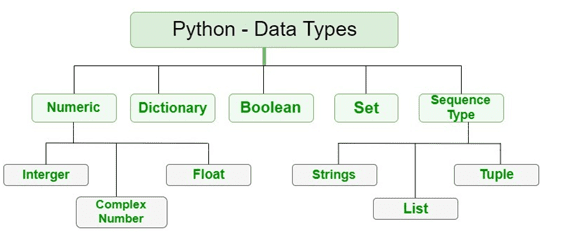
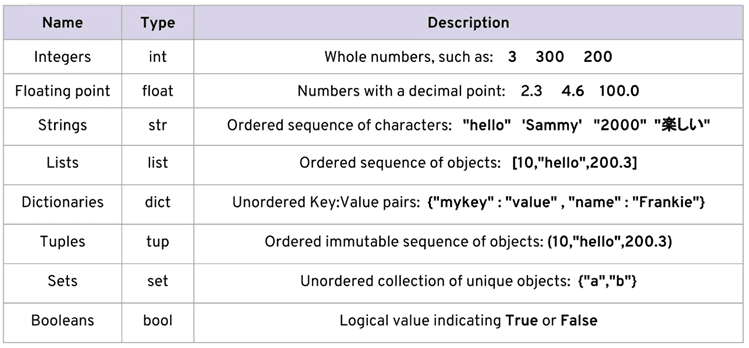
Built-in data type of python are as follows:
                            
Let us discuss about Numeric Data type

Numbers
The Python interpreter acts as a simple calculator, You can write an expression and interpreter will display the value. Expression syntax is straight forward: the operators +, -, * and / work just like in most other languages (for example, Pascal or C); parentheses (()) can be used for grouping.

Examples

>>> 7 + 3
10
>>> 70 - 5*6
40
>>> (70 - 5*6) / 4
10.0
>>> 9 / 5  # division always returns a floating point number
1.8

There are three distinct numeric types: integersfloating point numbers, and complex numbers. In addition, Booleans are a subtype of integers.

Integers
This value is represented by ‘int class. It contains positive or negative whole numbers (without fraction or decimal). In Python there is no limit to how long an integer value can be.

Float
This value is represented by ‘float class. It is a real number with floating point representation and specified by a decimal point.

Complex Numbers
Complex number is represented by ‘complex class. It is specified as (real part) + (imaginary part)j. For example – 5+8j

Basic Operations on Numeric Type
The integer numbers (e.g. 2, 4, 20) have type ‘int’, the ones with a fractional part (e.g. 5.0, 1.6) have type  ‘float’.

Division (/) always returns a float. To do floor division and get an integer result (discarding any fractional result) you can use the // operator; to calculate the remainder you can use %:

Examples
>>> 7+3 # addition operator
10
>>> 7-3 #minus operator
4
>>> 7*3 #multiplication operator
21
>>> 17 / 3  # classic division returns a float
5.666666666666667
>>> 
>>> 17 // 3  # floor division discards the fractional part
5
>>> 17 % 3  # the % operator returns the remainder of the division
2
>>> 5 * 3 + 2  # result * divisor + remainder
17

With Python, it is possible to use the ** operator to calculate powers

>>> 5 ** 2  # 5 squared
25
>>> 2 ** 7  # 2 to the power of 7
128

The equal sign (=) is used to assign a value to a variable. Afterwards, no result is displayed before the next interactive prompt:

>>> width = 20
>>> height = 5 * 9
>>> width * height
900

If a variable is not “defined” (assigned a value), trying to use it will give you an error:

>>> n  # try to access an undefined variable
Traceback (most recent call last):
  File "<stdin>", line 1, in <module>
NameError: name 'n' is not defined

There is full support for floating point; operators with mixed type operands convert the integer operand to floating point:

>>> 4 * 3.75 - 1
14.0

In interactive mode, the last printed expression is assigned to the variable _. This means that when you are using Python as a desk calculator, it is somewhat easier to continue calculations, for example:

>>> tax = 12.5 / 100
>>> price = 100.50
>>> price * tax
12.5625
>>> price + _
113.0625
>>> round(_, 2)
113.06

This variable should be treated as read-only by the user. Don’t explicitly assign a value to it — you would create an independent local variable with the same name masking the built-in variable with its magic behavior.

All numeric types (except complex) support the following operations:

   
Operation
Result
Full documentation
x + y
sum of x and y
   
x – y
difference of x and y
   
x * y
product of x and y
   
x / y
quotient of x and y
   
x // y
floored quotient of x and y
   
x % y
remainder of x / y
   
-x
x negated
   
+x
x unchanged
   
abs(x)
absolute value or magnitude of x
int(x)
x converted to integer
float(x)
x converted to floating point
complex(re, im)
a complex number with real part ‘re, imaginary part ‘im. im defaults to zero.
c.conjugate()
conjugate of the complex number c
   
divmod(x, y)
the pair (x // y, x % y)
pow(x, y)
x to the power y
x ** y
x to the power y