Showing posts with label best placement college in india. Show all posts

Saturday, 7 March 2020

Do You Need To Be Good At Math For Computer Science?

If there is one subject that has equal lovers and haters, it is definitely mathematics. Math is one of the most important subjects of our school time and interestingly many career choices depend on how good you are in the subject. No wonder, every student asking this question – is it important to be good at Math to pursue computer science? The question becomes imperative because if you aspire to take admission in the best engineering college for computer science, it is important to have expert-level in all three subjects of Non Medical – Physics, Chemistry and Math. So before we give you a concrete answer to the question, let us first tell you how computer science and Math are related.

Computer science is all about using computer programs and practical approach to creating applications related with computers. So how does mathematics fit in between computer science and programming? The answer is – there are certain subjects of mathematics like calculus, probability, statistics, linear algebra, linear programming etc that are purely related with computer science and computer programming. So all those students who wish to pursue their higher education in one of the best engineering colleges for computer science and build their career in creating applications or programming, good mathematics is the best bonus they can ask for!

The simple way to correlate your career interest and choice is that everyone who is good at mathematics can surely go for computer science but that shouldn’t stop you from taking computer science if you are just an average student in Math. Computer science is a vast field and there are many things that a student can do with just basic understanding of Math like web app development, operating systems etc. You can excel in other branches than programming or coding in computer science engineering even if you are not a topper in mathematics.

Student who wants to build a flourishing career in programming, good mathematical mind is a big strength. In fact, you are not expected to be good at arithmetic, calculations or geometry, computer science engineering is best done when students have a strong mathematical thinking.

For that matter, if you wish to do engineering in any other field than computer science; say mechanical engineering or electronics engineering; your marks and expertise level in three subjects – Physics, Chemistry and Mathematics, decide which institute you get admission in to and for what branch of engineering. So computer science engineering students are by default expected to be good at Math. Moreover, if you want to build a career in artificial intelligence, command in statistics, calculus, probability, logic and a little bit of knowledge of all these branches of mathematics would help you learn faster and better.


Thursday, 30 January 2020

Motors in Electric Vehicle

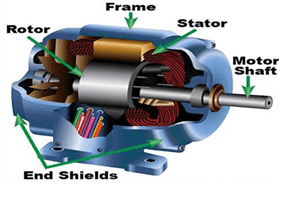
Due to worse effect of fossil fuel on environment, Electric vehicle (EV) was introduced. The core element of the EV, apart from Batteries, which replaces the Internal Combustion engines is an Electric motor. Older designs used standard DC motors, which are relatively economically controlled when driven with batteries. New designs use either AC Induction motors or Permanent Magnet Rotor AC motors, driven by electronic inverters. In general, lower power applications will use the PM AC motors which are slightly more efficient for a given task, while high-performance vehicles will use induction motors since they are capable of very large acceleration torques relative to their weight for short intervals, until they overheat. All new Electric Vehicles and even hybrids use AC electric motors. They are lighter, more powerful and can be used as a generator makes power as you slow down or brake called Regenerative braking. 
Permanent Magnet AC Motor
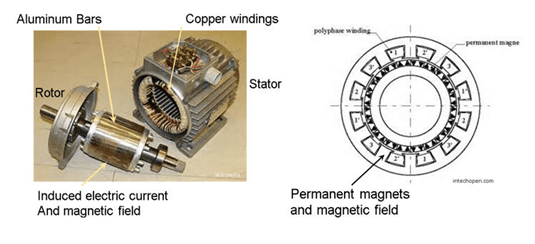
Permanent magnet AC motors (PMAC) are just like standard induction AC motors except they have permanent, rare-earth magnets attached to their rotors. Having these permanent magnets instead of electromagnets reduces energy losses in the motor. They are also called synchronous AC motors.  Most of the automotive manufacturers use PMAC motors for their hybrid and electric vehicles. For example, Toyota Prius, Chevrolet Bolt EV, Ford Focus Electric, zero motorcycles S/SR, Nissan Leaf, Hinda Accord, BMW i3, etc use PMAC motor for propulsion.

AC Induction Motors
Induction motor works on the principle of induction where electro-magnetic field is induced into the rotor when rotating magnetic field of stator cuts the stationary rotor. Induction machines are by far the most common type of motor used in industrial, commercial or residential settings. Squirrel cage induction motors have a long life due to less maintenance. Induction motors can be designed up to an efficiency of 92-95%. The drawback of an induction motor is that it requires complex inverter circuit and control of the motor is difficult.

Typically, most of the manufacturers use synchronous motors, but whether it is a permanent magnet or electromagnet strongly influences the performance. The key difference is that AC induction motors have to use electricity to generate the magnetic currents inside the motor, which cause the rotor to spin, whereas a permanent magnet motor doesn’t require that additional current since its magnets—created from rare-earth materials—are always “on.”

Data types in Python: Numeric Data Type

Python is a clear and powerful object-oriented programming language, comparable to Perl, Ruby, Scheme, or JavaIn my last blog we have discussed the key features of python. Now we are going to dive into the programming concepts of python. In this blog we will discuss about data types used in the python
   
Data Types
Data types are the classification or categorization of data items. It represents the kind of value a particular variable can hold and tells what operations can be performed on that particular data.
   
Since everything is an object in Python programming, data types are actually classes and variables are instance (object) of these classes. The type of a variable in the python is decided by the type of value assigned to that variable.
   
Example:
   
# type() function is used to identify the datatype of variable or object.
>>> x = 10
>>> type(x)
<class 'int'>
>>> x = 10.0
>>> type(x)
<class 'float'>
>>> x = 5+8j
>>> type(x)
<class 'complex'>
>>> x = 'Mukesh'
>>> type(x)
<class 'str'>
>>> x = ['Mukesh','Kumar']
>>> type(x)
<class 'list'>
>>> x = ('Mukesh', 'Kumar')
>>> type(x)
<class 'tuple'>
>>> x = {'fname':'Mukesh', 'lname':'Kumar'}
>>> type(x)
<class 'dict'>
>>>
   

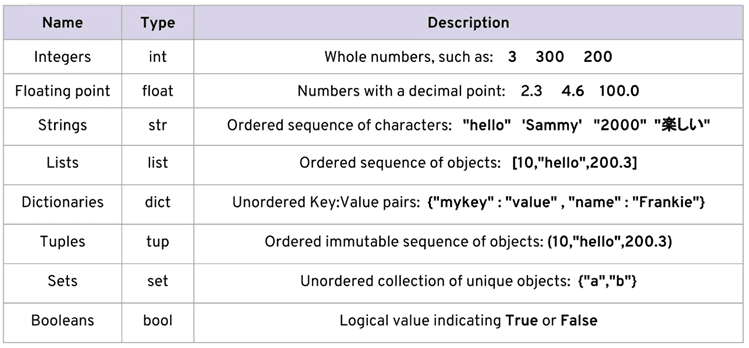
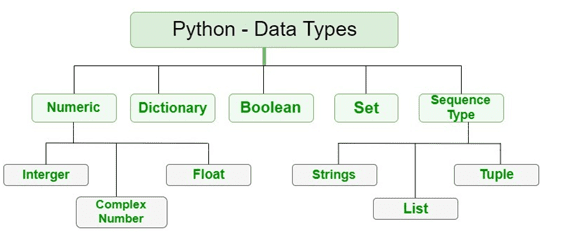
Built-in data type of python are as follows:
                            
Let us discuss about Numeric Data type

Numbers
The Python interpreter acts as a simple calculator, You can write an expression and interpreter will display the value. Expression syntax is straight forward: the operators +, -, * and / work just like in most other languages (for example, Pascal or C); parentheses (()) can be used for grouping.

Examples

>>> 7 + 3
10
>>> 70 - 5*6
40
>>> (70 - 5*6) / 4
10.0
>>> 9 / 5  # division always returns a floating point number
1.8

There are three distinct numeric types: integersfloating point numbers, and complex numbers. In addition, Booleans are a subtype of integers.

Integers
This value is represented by ‘int class. It contains positive or negative whole numbers (without fraction or decimal). In Python there is no limit to how long an integer value can be.

Float
This value is represented by ‘float class. It is a real number with floating point representation and specified by a decimal point.

Complex Numbers
Complex number is represented by ‘complex class. It is specified as (real part) + (imaginary part)j. For example – 5+8j

Basic Operations on Numeric Type
The integer numbers (e.g. 2, 4, 20) have type ‘int’, the ones with a fractional part (e.g. 5.0, 1.6) have type  ‘float’.

Division (/) always returns a float. To do floor division and get an integer result (discarding any fractional result) you can use the // operator; to calculate the remainder you can use %:

Examples
>>> 7+3 # addition operator
10
>>> 7-3 #minus operator
4
>>> 7*3 #multiplication operator
21
>>> 17 / 3  # classic division returns a float
5.666666666666667
>>> 
>>> 17 // 3  # floor division discards the fractional part
5
>>> 17 % 3  # the % operator returns the remainder of the division
2
>>> 5 * 3 + 2  # result * divisor + remainder
17

With Python, it is possible to use the ** operator to calculate powers

>>> 5 ** 2  # 5 squared
25
>>> 2 ** 7  # 2 to the power of 7
128

The equal sign (=) is used to assign a value to a variable. Afterwards, no result is displayed before the next interactive prompt:

>>> width = 20
>>> height = 5 * 9
>>> width * height
900

If a variable is not “defined” (assigned a value), trying to use it will give you an error:

>>> n  # try to access an undefined variable
Traceback (most recent call last):
  File "<stdin>", line 1, in <module>
NameError: name 'n' is not defined

There is full support for floating point; operators with mixed type operands convert the integer operand to floating point:

>>> 4 * 3.75 - 1
14.0

In interactive mode, the last printed expression is assigned to the variable _. This means that when you are using Python as a desk calculator, it is somewhat easier to continue calculations, for example:

>>> tax = 12.5 / 100
>>> price = 100.50
>>> price * tax
12.5625
>>> price + _
113.0625
>>> round(_, 2)
113.06

This variable should be treated as read-only by the user. Don’t explicitly assign a value to it — you would create an independent local variable with the same name masking the built-in variable with its magic behavior.

All numeric types (except complex) support the following operations:

   
Operation
Result
Full documentation
x + y
sum of x and y
   
x – y
difference of x and y
   
x * y
product of x and y
   
x / y
quotient of x and y
   
x // y
floored quotient of x and y
   
x % y
remainder of x / y
   
-x
x negated
   
+x
x unchanged
   
abs(x)
absolute value or magnitude of x
int(x)
x converted to integer
float(x)
x converted to floating point
complex(re, im)
a complex number with real part ‘re, imaginary part ‘im. im defaults to zero.
c.conjugate()
conjugate of the complex number c
   
divmod(x, y)
the pair (x // y, x % y)
pow(x, y)
x to the power y
x ** y
x to the power y
   

Friday, 6 December 2019

MarkTech: An Annual International Conference on Marketing


The Department of MBA at ITS Engineering College strives to achieve excellence and always eager to share the knowledge of current and future business scenarios with the students by industry experts. Seminars/Conferences are large scale events that bring people in the same industry together to learn and share knowledge about contemporary management trends and issues. This helps our students and faculty members in being knowledgeable and updated about current concepts and technologies. Attending such confluences of industry experts through Seminars/ Conferences is one of the best ways to stay ahead in the ever-changing industry.

On 4th April 2019, the department organised “MarkTech-2019”, the first International Conference on marketing on the theme “Marketing to Centennials in Digital World”. Mr. Hitesh Sood, AVP and Head (Marketing), Vodafone Idea Ltd. was the Chief Guest and Mr.Inbarajan P., Senior Vice-President, Growth and strategy, Info-Edge India Ltd. graced the occasion as the Keynote Speaker for the day.


Digital Marketing is the key mantra for the success of business firms. The current innovation and use of digital technology have initiated global marketing strategies and practices. Objective of “MarkTech-2019” was to provide a platform to academicians & industry practitioners, to discuss their views, research and share their ideas about marketing strategies to centennials in the digital world. The conference helped in knowledge sharing, understanding and promoting the best marketing practices/barriers focusing centennials in the digital world and motivated researchers to address the new gap/ issues in this emerging research topic.

http://www.itsengg.edu.in/blogs/post/An-International-Conference-on-Marketing

Thursday, 5 December 2019

National Instruments & e-Yantra Lab at ITS Engineering College

The ECE department of I.T.S Engineering College was established in the year 2009 with the main aim to be more responsive and more responsible towards society, towards nature for an amiable existence. Ability to communicate all types of information from any place, any time is changing society from Information age to intelligent age. As an engineer to be relevant, great efforts will be needed in every sub branch of this discipline, be it Communication, Embedded, VLSI or Biomedical. Electronics is touching every aspect of everyday life.

For successful Engineering Practice, able to associate the learning of basic & advanced courses in the field of Electronics & Communication along with state of art automation tools like National Instruments Lab and e-Yantra Lab these are centre of excellence of ECE Department. In the progress of this manner one of our student team won state level event Dr.APJ Abdul Kalam Technical University, Lucknow,U.P

e-Yantra is in collaboration with IIT Mumbai and Sponsored by MHRD, Govt of India which aims to produce next generation embedded system and robotics engineers with practical outlook to solve real world problems. Our students get an opportunity to learn state of art technology behind embedded systems and robotics and compete with pioneer minds at state and national level competitions.  The students used to get trained on Fire Bird V, a robotic research platform which is based on AVR.

Certified NI Lab view academy for training, certifications, hardware Development internship and job opportunities. Focusing for international certifications like certified LabVIEW associate developer (CLAD), Certified Developer (CLD) and Certified Lab View Architecture (CLA).
Even imaging a life bereft of electronic gadgets seems impossible in today’s world. There is no field across the globe where one cannot find the usage of electronics and communication engineering. Perhaps that is why electronics have become the vertebrae of digital technology.
According to collective survey by ASSOCHAM and NEC Corp the electronics market of India is predicted to reach $400 billion by the year 2010 at a 41% CAGR rate.


#topplacementcollege #bestplacementcollege #topengineeringcollege #bestengineeringcollege #itsengineeringcollege #topengineeringcollegencr #topengineeringcollegedelhi #topengineeringcollegeindia #engg #engineering

Friday, 22 November 2019

Bridging from College to Corporate

We at ITS Corporate Resource Center (CRC) strive to achieve excellence and always think ahead to bridge the gap between academia and industry. CRC focuses on right balancing of quality students with quality corporate placements to give equal opportunities to all the students from various branches.


We are amongst one of the top Engineering and Management Colleges in Delhi NCR providing best Placement Opportunities. Placement drives are well planned and strategized so that maximum students across all the branches are exposed to placement industry interface. We hold a strong placement record in conducting placement drives and are first preferred campus to conduct mass placement drives too. We hold strong 10+ years of corporate recruitment experience with good HR networking at PAN India level.


The uniqueness about ITS CRC is focusing on company requirement, providing company specific training and preparing our students for the job. As a result they are more marketable and well placed in Corporate. With this mindset for skill building and interdisciplinary collaborative learning, a multi-industrial Center of Excellences (COE) has been established in our institution. The versatility of the COEs are dedicated for various branches like National Instruments Innovation Centre (EEE/ECE),  SMC Pneumatic Centre (ME/Civil), Rockwell Automation Centre(EEE/ECE), SYSCOM Innovation Development (CSE), iOS App Development Centre (CSE), Android App Development Centre(CSE), Embedded Systems and Robotics Centre (EEE/ECE) , SALT Software Testing Centre and Mobility Innovation Development Centre (CSE), RSystems (CSE). Students from each branch are exposed to the edge of latest trends on technology on their core domain which is booming in the industry.

Our placement mechanism receives a great deal of our attention with a guarantee that every single student of ITS engineering and Management college steps in to the professional world with flying colours.